
 Back
Back
Book a Consultation

July 29, 2026
A melanoma diagnosis tends to arrive in pieces. A spot gets biopsied, a report comes back, a referral gets made, and suddenly there are more questions than anyone has answered. The path forward involves appointments, reports, and a lot of waiting in between.
This page is meant to slow that down. We will walk through what melanoma is, the warning signs worth watching, what happens after a biopsy, and how stage shapes the plan. If you are in Brooksville, Spring Hill, Weeki Wachee, or nearby Hernando County, a local oncology team can help you read the results and plan what comes next.
Melanoma starts in melanocytes, the cells that make pigment in your skin and eyes. It usually appears on the skin, but it can also show up in the eye (intraocular or ocular melanoma), on the palms or soles, or under a fingernail or toenail.
In 2026, about 112,000 invasive melanomas are expected to be diagnosed in the United States. Melanoma is less common than basal cell or squamous cell skin cancers, but it draws more attention because it spreads more readily if not caught early.
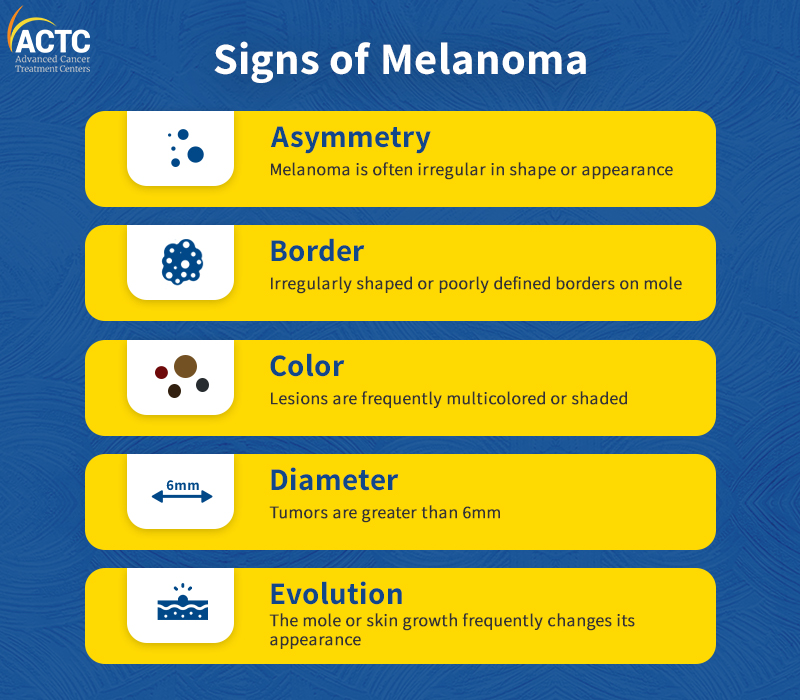
Most people first notice melanoma as a change in a mole or a new spot on the skin. The ABCDE framework is the most widely used tool for recognizing features that deserve a closer look:
Asymmetry: One half of the spot does not match the other.
Border: Edges look ragged, blurred, or notched rather than smooth.
Color: More than one shade in the same spot, including brown, black, tan, red, white, or blue.
Diameter: Often larger than 6 mm (about the size of a pencil eraser), though some melanomas are smaller.
Evolving: The spot changes in size, shape, color, or how it feels over weeks or months.
The piece the ABCDEs miss: a spot that is new, looks different from your other moles, or itches, bleeds, or will not heal deserves a look, even if it does not check every letter. Anyone can develop melanoma, including people with darker skin, where lesions more often appear on the palms, soles, or under nails.
In Florida, sun exposure is part of daily life. Two short reads pair well with this page: 4 ways to prevent skin cancer and how to choose the right sunscreen.
Melanoma can affect anyone, whatever your skin tone. Certain factors raise the likelihood:
UV exposure: Sunlight and tanning beds, especially a history of blistering sunburns.
Many or atypical moles: A higher number of moles, or unusual-looking moles, increases risk.
Personal or family history: A prior melanoma or a first-degree relative with melanoma raises risk.
Weakened immune system: Immunosuppression from illness or medications can increase susceptibility.
Inherited gene changes: Some families carry gene variants that increase melanoma risk.
Knowing your risk helps you decide how closely to watch your skin and how often to see a dermatologist.
Once the biopsy comes back as melanoma, a few things tend to happen in sequence.
Pathology review: The report describes thickness (Breslow depth), whether the surface is broken (ulceration), and the surgical margin. Thickness and ulceration help determine stage. Margin status helps guide whether more tissue needs to be removed.
Staging: Stage is not judged by how a spot looks. It is assigned after pathology using thickness, ulceration, lymph node involvement, and whether melanoma has spread.
Wide local excision: A surgeon usually removes more tissue around the biopsy site.
Sentinel lymph node biopsy (SLNB): For some melanomas, a surgeon checks the first lymph node the area drains to. This sentinel node biopsy is a sampling procedure, not the removal of all lymph nodes in the area.
Imaging when indicated: A computed tomography (CT) or positron emission tomography (PET) scan may be ordered if there is concern about spread.
Mutation testing when relevant: Some melanomas are tested for gene changes such as BRAF, because results can affect targeted-therapy choices. Your team will arrange testing through a certified lab when systemic therapy is on the table.
The waiting between these steps is hard. Bring your biggest questions to each visit and write the answers down.
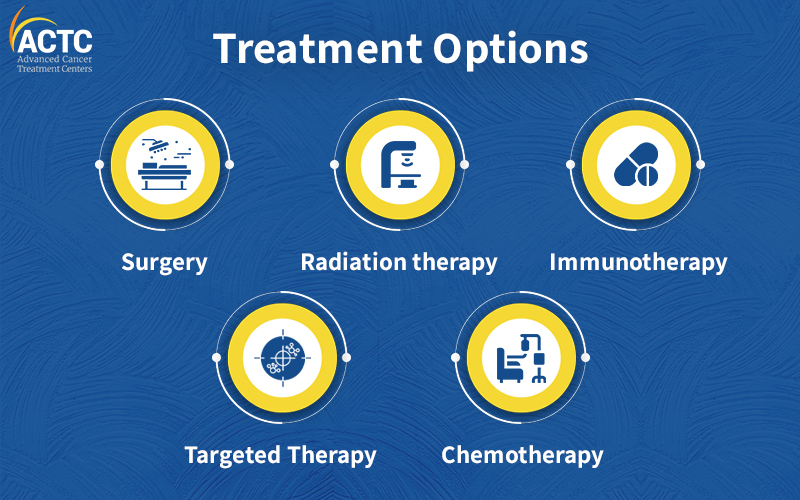
Treatment depends on stage, location, tumor features, and your overall health. Here is how each option fits into the picture:
Surgery: The primary treatment for early-stage melanoma. The tumor and a margin of surrounding tissue are removed. For stage 0 and stage I, surgery is often the complete treatment plan.
Immunotherapy: Treatments that help the immune system recognize and attack melanoma cells. Checkpoint immunotherapy, including drugs such as pembrolizumab and nivolumab, is used for higher-risk stage II disease as adjuvant therapy to lower the chance of return, for regional stage III disease, and for unresectable or metastatic stage IV melanoma. It is much less likely to cause hair loss than chemotherapy, though not impossible, and immune-related effects on the thyroid, skin, gut, lungs, or liver can be serious if missed early.
Targeted therapy: Some melanomas carry a BRAF gene mutation. When that mutation is present, BRAF and MEK inhibitor combinations can block the proteins driving cancer growth. Your team will review whether mutation testing is appropriate for your case.
Radiation therapy: Used in selected situations, including symptom management and certain higher-risk post-surgical settings. A radiation oncology team determines the schedule and dose based on your specific case.
Chemotherapy: Still an option for advanced or recurrent melanoma, though immunotherapy and targeted therapy now play a more central role in most treatment plans.
If you are on immunotherapy, labs and check-ins are part of the plan. If you develop sudden trouble breathing, call 911 first. For new or worsening rash, diarrhea, belly pain, cough, yellowing of the skin or eyes, or unusual fatigue between visits, call your oncology team the same day.
For stage III and IV melanoma, combination or sequential therapy is common. Treatment planning is individualized, and the right sequence depends on factors your oncology team reviews with you.
Uveal (eye) melanoma is a different disease from skin melanoma with its own treatment path. If the spot is on the eyelid, eyelid cancer content may be relevant to your situation.
If the concern is inside the eye, ask your team which type of eye-related melanoma you are dealing with and which specialist should guide that part of your care. That distinction matters because the treatment paths are not the same.
Start with the ABCDE checklist: asymmetry, irregular border, more than one color, diameter larger than 6 mm, and evolving over time. Add a check for any spot that is new, itching, or bleeding, even if it passes all five letters.
Can you live a long life after having melanoma?Often, yes, especially when melanoma is found early. Many people return to normal routines after surgery for stage 0, I, or II disease, with regular skin checks and follow-up. For higher stages, plans are longer and follow-up matters more.
What does first-stage melanoma look like?It depends, and appearance is not how stage is decided. Stage I means a thin melanoma without spread to lymph nodes, but two stage I lesions can look very different. Stage is assigned by pathology after biopsy, not by sight.
What do clear margins or a negative lymph node mean?They are encouraging findings, and they lower the risk of recurrence. They do not mean follow-up is over. Skin surveillance and any imaging your team recommends stay part of care, and how often depends on your stage and your oncologist's guidance.
A melanoma diagnosis brings a lot of uncertainty, and reading about it online can make that worse before it makes it better. You do not have to sort it out alone.
If you are in Brooksville, Spring Hill, or nearby Hernando County, our team can help you read your pathology and plan next steps. Treatment options on site include immunotherapy and targeted therapy.
We also coordinate radiation when needed. Our financial counselors can help you understand coverage and out-of-pocket costs.
Call us at 352-345-4565 or book an appointment when you are ready.


July 17, 2026
Sadness during cancer is human. Depression is a treatable medical cond...
KNOW MORE

July 17, 2026
A clear, week-by-week guide to post-chemo recovery at home. What to ex...
KNOW MORE

July 17, 2026
Radiation can change how your mouth feels and food tastes. Here is wha...
KNOW MORE
January 07, 2026
A chemo port is a small device placed under your skin that makes recei...
KNOW MORE
December 24, 2025
It's natural to wonder if testosterone replacement therapy (TRT) is sa...
KNOW MORE
December 24, 2025
A rash that will not calm down is scary, especially when it changes or...
KNOW MORE
Subscribe to our newsletter
Social Links


 15211 Cortez Boulevard, Brooksville, Florida 34613