
 Back
Back

Book a Consultation

May 01, 2026
A rare cancer diagnosis can leave you disoriented fast. You may be hearing a new term, waiting on a biopsy review, or sorting out who handles which part of care.
Adenoid cystic carcinoma, or ACC, is rare. It often grows slowly, but slow growth does not make it simple. ACC can travel along nerves, return years later, and sometimes spread to distant areas.
Our role at ACTC in Brooksville is to help you understand the diagnosis and what to ask next. This guide walks through the basics for patients and caregivers in Hernando County.
When you first hear the name, your first question may be where this cancer began. With ACC, the answer usually points to glands that make saliva.
ACC most often starts in salivary glands of the head and neck. It can begin in larger glands near the jaw or ears. It can also start in smaller glands in the palate, mouth, throat, sinuses, or airway.
Less commonly, ACC starts outside the mouth and throat, including the tear gland, breast, or skin. This overview of adenoid cystic carcinoma covers the basics in one place.
Most people did not do anything to cause ACC. There is usually no single clear reason it developed. Older age and prior head or neck radiation are linked to salivary gland cancers in general, though ACC-specific causes are not well understood.
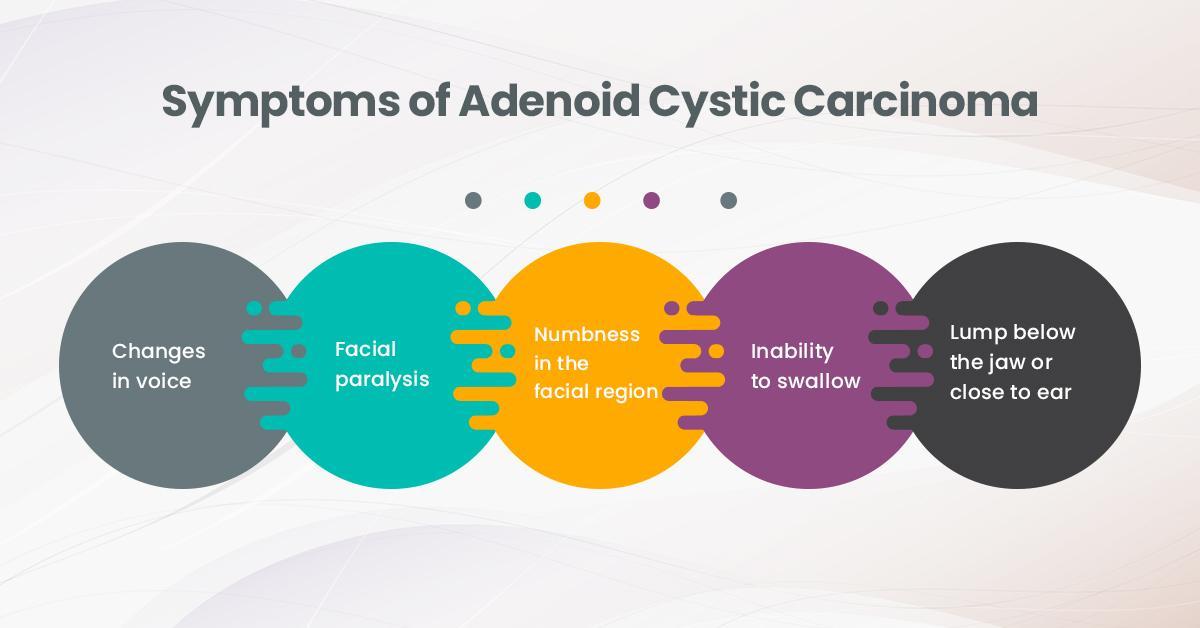
You may not notice symptoms right away. When they appear, they usually come from pressure, swelling, pain, or nerve irritation near the tumor.
Common things people notice include:
A lump or swelling: This may show up in the mouth, cheek, jaw, near the ear, or in the neck. It may be painless at first.
Numbness or weakness: Tingling, numbness, or weakness in the face can happen when the tumor involves a nerve.
Pain that does not go away: Ongoing pain in the face, mouth, jaw, or throat is worth checking.
Trouble swallowing or opening the mouth: A growing tumor can make chewing, swallowing, or jaw movement harder.
Voice, nose, or eye changes: Hoarseness, nasal blockage, or eye changes can happen when ACC starts in a less common area.
A tumor near the tear gland creates different symptoms than one in the palate. That is one reason lacrimal gland tumor treatment is planned differently from ACC in the mouth.
A symptom by itself does not mean cancer. Still, a new lump, unexplained facial numbness, or lasting swallowing trouble is worth a medical evaluation.
After a scan or exam raises concern, most people want a clear answer fast. Imaging shows where a tumor may be. A biopsy confirms what it is.
Because ACC is rare, an experienced pathology read can matter. It is reasonable to ask whether your biopsy has been reviewed by a pathologist familiar with salivary or rare head and neck tumors.
The workup may include:
Physical exam: Your doctor checks the mouth, throat, neck, face, and nerve function.
Imaging: MRI, CT, PET, ultrasound, or endoscopy can help map the tumor.
Biopsy: Tissue testing confirms ACC and adds details that shape the plan.
Record review: Prior scans, pathology, surgery notes, and radiation records help avoid gaps.
PET is one tool, not a final answer. Slower-growing ACC may not always show clearly on PET, so a normal PET does not rule cancer out.
ACC treatment is not one-size-fits-all. Your plan depends on where the tumor started, whether it can be removed safely, and whether there is evidence of spread.
For localized ACC, surgery is often the first step. Surgery for head and neck tumors is performed at a surgical center, not at ACTC. Our oncology team coordinates around your surgeon's recommendations.
Radiation is commonly added after surgery for ACC. It is not a sign that surgery failed. Radiation aims to lower the chance that cancer cells remain or return.
A few questions usually shape the plan:
Where the tumor started: A palate, airway, tear gland, or major salivary gland tumor can require a different approach.
Whether nerves are involved: ACC often grows along nerves, so this finding affects surgery and radiation planning.
What surgery showed: Margins and pathology details help shape the next step.
Evidence of spread: Imaging may look at the neck, chest, or other areas when needed.
What matters most to you: Your overall health, swallowing, speech, and personal priorities are part of the plan.
Drug treatment is not automatic for ACC. There is no FDA-approved systemic therapy specifically for ACC, and routine chemotherapy with radiation is not standard outside a clinical trial.
In recurrent or metastatic ACC, your team may discuss medication options, tumor profiling through a certified lab, or a clinical trial.
For a wider view, adenoid cystic treatment and salivary gland cancer treatment place ACC inside the larger family of head and neck cancers.
For tumor pattern detail, adenoid cystic carcinoma types symptoms treatment covers cribriform, tubular, and solid pathology.
Follow-up for ACC is not an afterthought. It is part of treatment, often for many years.
This cancer can return long after the first treatment ends. It may come back near the original site, along nerves, or in distant areas. The lungs are one place doctors watch carefully.
Follow-up usually includes:
Symptoms to report: New pain, numbness, cough, voice changes, swallowing trouble, or weight loss.
Exams over time: Your doctor checks the treated area and nearby structures on a schedule.
Imaging: Follow-up usually relies on scans rather than blood tests alone.
Records to keep: Pathology, surgery notes, scan reports, and radiation summaries.
Some patients with slow changes are watched closely. Others need more treatment. The right next step depends on growth, symptoms, location, and your overall plan.
For related diagnoses, this deep dive into salivary gland cancer and a primer on mouth cancer can help frame symptom overlap.
Most ACC concerns are not emergencies, but some symptoms need immediate care. Call 911 first for severe chest pain, sudden trouble breathing, or heavy bleeding that will not stop. Also call 911 for sudden facial numbness or weakness, especially on one side, or sudden speech changes.
Call the care team the same day for urgent but non-life-threatening symptoms, like a new lump or a side effect that worries you. Call right away for fever during chemotherapy, especially 100.4°F (38°C) or higher. Follow any after-hours instructions your team gave you.
When in doubt, call. We would rather hear from you early than have you wait it out.
Not necessarily. Many ACC tumors grow slowly, but slow growth does not make ACC harmless. Some grow along nerves, some return years later, and some spread to distant sites.
It varies. Outlook depends on tumor location, stage, size, margins, nerve involvement, spread, overall health, and treatment plan. A single number cannot predict an individual outcome.
It depends. Surgery is often the main option when the tumor can be removed safely. If surgery is not feasible, radiation may carry the main role.
It varies. Some parotid lumps are benign, and many are. If a parotid lump is cancer, seriousness depends on the tumor type, stage, nerve involvement, lymph nodes, and spread.
Yes. Long-term follow-up matters because ACC can return long after initial treatment ends, including in the lungs or along nerves.
Bring your biopsy report, recent scan reports, a medication list, and written questions. That gives our team a clearer starting point.
A rare cancer diagnosis brings a lot of uncertainty, and you do not have to navigate it alone. Some parts of ACC care, including head and neck surgery, happen at outside centers. That is normal for a rare tumor.
At ACTC in Brooksville, we can help you review the records you have and see where local oncology and radiation oncology fit. Imaging, lab work, infusion care, and financial counseling for coverage questions can also be part of the visit.
We will tell you plainly what we support locally in Brooksville, Spring Hill, and Weeki Wachee. We will also flag where an outside referral makes more sense.
For records review, care coordination, or your next conversation, call 352-345-4565 or use https://actchealth.com/appointment to book an appointment.


July 17, 2026
Sadness during cancer is human. Depression is a treatable medical cond...
KNOW MORE

July 17, 2026
A clear, week-by-week guide to post-chemo recovery at home. What to ex...
KNOW MORE

July 17, 2026
Radiation can change how your mouth feels and food tastes. Here is wha...
KNOW MORE
January 07, 2026
A chemo port is a small device placed under your skin that makes recei...
KNOW MORE

December 24, 2025
It's natural to wonder if testosterone replacement therapy (TRT) is sa...
KNOW MORE

December 24, 2025
A rash that will not calm down is scary, especially when it changes or...
KNOW MORE
Subscribe to our newsletter
Social Links


 15211 Cortez Boulevard, Brooksville, Florida 34613